
Page
CHAPTER 2: PUBLISHING LIST MANAGEMENT
Completion requirements
CHAPTER 2: PUBLISHING LIST MANAGEMENT

The aim of this chapter is to help you build an understanding of list building and front list and back list management.
2.1. Important considerations in list-building
After studying this section, you must be able to:- discuss the concepts and principles of publishing list-building with reference to their application within a business strategy
- justify the importance of list balance and variety and analyse mechanisms to achieve this.
2.1.1. Concepts and principles of publishing list-building
In many ways, the concept of a publishing list is central to commercial publishing, and the management of that list is very important to the wider success of the business.
A publishing list is the list of books or products that a particular commissioning editor, or publishing company, is responsible for managing.
Many publishing companies with more than one commissioning editor give each commissioning editor a topic or defined area within which to work. This avoids the potential situation where two staff members each present a proposal for a very similar book – this would be a waste of resources. So, for example, a commissioning editor may be in charge of biographies and guide books, while her fellow commissioning editor may look after novels in Afrikaans and maps. At another publishing company, a commissioning editor may be responsible for medical textbooks, while another manages engineering textbooks. As well as not wasting resources, this approach allows commissioning editors to develop a real understanding of their own area, becoming familiar with the respected academics, important conferences, key celebrities, and important current issues (depending on the type of publishing). (Some commissioning editors may be specialists or have advanced training in their area, but most do not – instead, they are good at making products that will sell.)
A publishing list is therefore often defined by the type of products on it (e.g. biographies, fiction) and/or their subject areas (e.g. politics, history, gardening).
A publishing list almost always has two parts:
- the front list (sometimes abbreviated as FL),
- and the back list (sometimes abbreviated as BL).
The front list is simply all those products that have been or will be published in the current financial year. You might also manage future front lists, i.e. front lists of books that will take a long time to develop, have already got ISBNs, have authors writing them, but are only going to publish in a few financial years’ time.
A back list is simply all those products that were published in prior financial years and that are still available for sale.
When you are working with front list and back list, it is essential to be clear about when your company's financial year begins and ends. A calendar year starts on the 1st of January and ends on the 31st of December, but a financial year may not match this. Many companies have financial years that start on 1 March every year, and end at the end of February every year. Other companies may start their financial year at any time of the year, for example, 1 June running through until 31 May. Knowing when your company's financial year begins and ends means you can work out which financial year a product was published in, and therefore whether it is a front list or back list title.
For example, a very short front list for a medical publishing list for the financial year 1 March 2018 to 28 February 2019 could look like this:
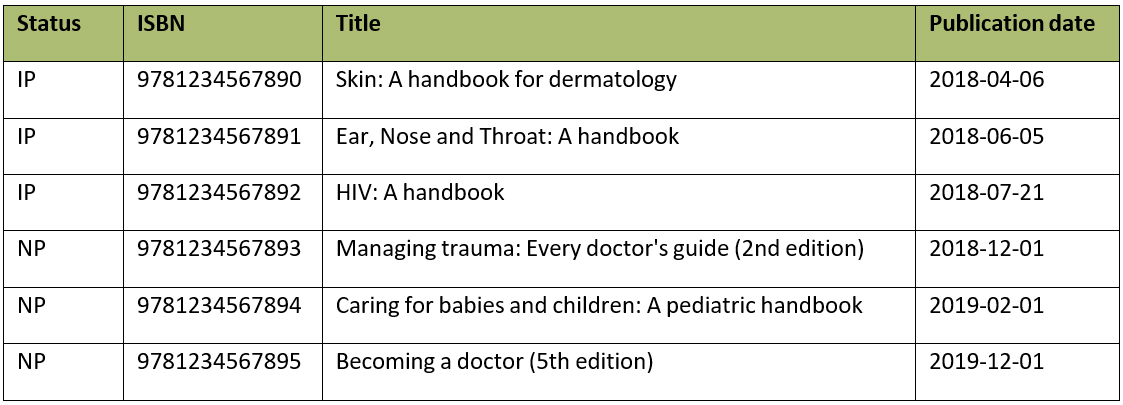
Table 2.1. Example of a short front list dated 2018-11-01 for the financial year 2018 to 2019
The three highlighted titles in the table have already been published – you can work this out because their status is given as IP. IP is an abbreviation for In Print and means that they have been published. The status of the other titles on the list is NP. This means that these titles are Not yet Published. They are instead forthcoming. (Your company may use different terms or abbreviations, but it’s likely they use the same underlying status categories.)
The other three titles in the list are planned to publish on 1 December 2018, 1 February 2019, and 1 December 2019. All the titles on this example of a front list have either been published, or they have been approved by senior managers and have been assigned ISBNs. They may not publish on exactly the date planned (given in the column on the far right), but they should publish very close to that date. If they don’t, the commissioning editor responsible for this list will have to give senior managers good reasons for why not. Delays in publication dates can affect sales badly, or even make a project unviable (e.g. if the timing of a project's publication was very time-sensitive, a delay can make publication pointless).
You also need an example of a short back list. Here is one for the same medical publishing list mentioned before:
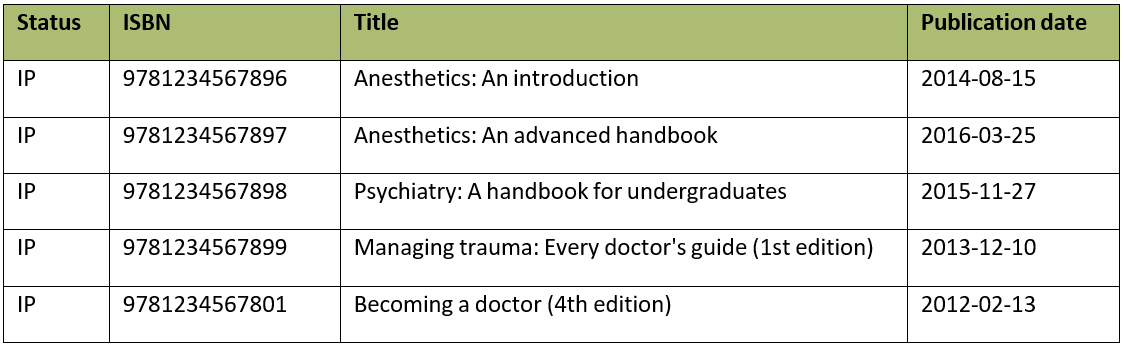
Table 2.2. Example of a short back list 2018-11-01
As you can see, this publishing list's back list has titles on it from a range of years (2012 to 2016), but all of them were published before the current financial year. Two of the titles on the back list are old editions of two of the titles on the front list. If you have a successful title, you may find that you need to make a new edition of it every few years. This is called a new edition cycle. It's important to keep track of the need for new editions, so that you don't fall behind.
If you are appointed as a commissioning editor, it's very likely that you will take over a publishing list with a back list and a front list. You will have to become familiar with the back list and look after it. You will also need to keep the front list on track. You may need to support those front list titles that have already published with marketing activities, or, if they have been selling well, ensure that there is enough stock available. But your most important job will be to focus on those front list titles that have not yet published – you will need to make sure that the authors deliver as they were briefed to do, that the editing of manuscripts is done well and on deadline, and that everything is on track to deliver the books on the publication date planned.
A publishing list must develop in a way that is in line with the publishing company’s overall strategy. For example, a company may decide to focus aggressively on a particular area of its list, such as sports biographies, while at the same time reducing its focus (time and effort spent) on picture books for children. The publishing lists should reflect this strategy. So, one could expect to see an increase in the number of sports biographies on the front list, as well as activities that are designed to draw attention to the sports biographies back list (such as rejacketing, special deals, promotional events).
Conversely, the list of picture books for children may have no front list titles (unless there were titles in production that could not be cancelled), and the back list may not be reprinted except for the most successful titles, or where significant sales to particular customers are certain. Alternatively, there could be a special promotion in order to reduce stock before titles are put out of print.
In terms of profitability, the back list is typically expected to be more profitable than the front list. Read more about profitability and the finances of publishing in Chapter 5. For now, it is enough to know that the direct costs (see the Glossary) of making the back list (e.g. editing, artwork, typesetting) have already been paid in the year of publication, and the only remaining costs are variable costs – printing costs, if any, and author royalties. The cost of making the front list, on the other hand, is taken into account financially in the year of publication, reducing the gross margin on these products. Once the front list from this year becomes the back list (as it will do when the financial year is completed and a new financial year starts), you would expect to see the gross margin rise.
Different sectors of the publishing industry typically get more or less of their revenue from their front list or their back list, because their sectors and their business strategies are different.
For example, a publishing list of educational reference books may include a sizeable back list and get the greatest proportion of its sales income from this back list. This is because educational reference books, like dictionaries or maps, can continue to sell for many years (perhaps five to 10) without a new edition. In contrast, a publishing list of celebrity biographies may have a much smaller back list with a much lower proportion of sales income from it, while its front list is very large and important. This is because this sector relies on new-ness – last year's celebrities may be of no interest this year, so celebrity biographies will sell for one or two years at the most, and then stop.
Very often, a commissioning editor may hope for a few significant successes each year from his front list, with the remainder of the front list generating lower sales. It would be unreasonable to expect every front list product to become a bestseller.
For many publishing companies, the profit from the back list provides the money to invest in and market the front list. In some cases, this allows a company to publish a product that it otherwise would not have been willing to take a risk on. For example, it might publish a product that seems to have potential, but will probably take longer than usual to become popular, or it might publish a product that represents the values of the company, but is unlikely ever to have substantial sales.
Since the development of digital publishing, online book sales of print or digital products, and social media, publishing companies have seen new sales patterns emerging. For example, an author's fifth novel may win a prize and become a bestseller, selling many more copies than the author's previous four books. In the past, readers may have had to visit second-hand or specialist bookstores hunting for earlier books, making it difficult for readers to find these titles. However, now that readers can easily find and buy an author's back list titles, publishing companies have noticed that back list titles can become very popular again. Readers who have enjoyed or heard about the prize-winning fifth novel can read digital samples of the earlier books, and buy them immediately, especially as digital editions. Readers can also very easily share with others their opinions about what they've read, e.g. on Twitter, Facebook, review websites like goodreads.com, or even on a blog of their own. This can create excitement about back list titles much more effectively than the original marketing campaign may have done. Back list sales may continue to grow, almost independent of the publishing company's actions.
Publishers have responded to the greater possibilities for back list titles by making digital editions of books that have long been out of print, have only been available in very small printruns, or only been available in a limited number of countries. They have also sometimes rejacketed all the books by an author, giving them a consistent look, and making older titles look more modern.
Another effect of an increasingly digital world has been to increase how easy it is to find a book (or a blog) on an obscure subject. Search engines, and the search functions on websites, produce instant results. The result is that a publishing company may be able to sell a niche product to people all over the world, rather than just to people in the country the business is based in. This makes a significant difference to whether that niche product is judged to be a viable project or not. After all, the more copies you can sell, the more viable the project is likely to be. Increased discoverability has given new life to the very large numbers of titles that sell small numbers of copies. These titles are sometimes called the “long tail”. They are the opposite of bestsellers, which are the very small number of titles that sell very large numbers of copies.
Increased discoverability means that what would not have been viable as a publishing project before the advent of digital may indeed be viable now – because people all over the world can find it. Keeping a product available digitally also costs much less than keeping it available in print form, and this has also made a huge different to the back list.
Every product on a publishing list can be described in terms of where it is on the product life cycle. Product life cycle is a theory about what happens to products during the time that they sell and are available to customers. Diagram 2.1 shows the product life cycle as a graph.
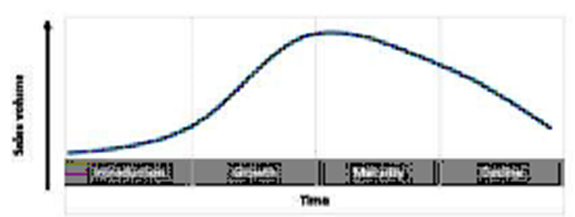
Diagram 2.1. The product life cycle
The idea is that, over time (measured on the horizontal axis of the graph), a product will sell more as it matures, until it eventually declines. Sales volume (in other words, how many times the product is sold) is measured on the vertical axis. When a product is introduced, its sales are low, but as the market starts to become familiar with the product and it enters the Growth stage, sales start increasing. Sales continue to increase until they reach their peak in the Maturity stage, after which they start to decline.
If you know that your new product is likely to follow this type of sales pattern, you will probably want to prolong the Growth and Maturity stages (so that the product gains as many sales as possible, for as long as possible), at the expense of the Introduction and Decline stages.
However, every product's sales will eventually decline. As a commissioning editor, how can you help to protect the company you work for from losing revenue as a product's sales declines?
For a commissioning editor, the aim is generally to propose and produce new products that can take over from older products that are entering the Maturity and Decline stages. If you manage to time the introduction of your new products well, you could end up with various products at different stages in the product life cycle, as Diagram 2.2 shows.
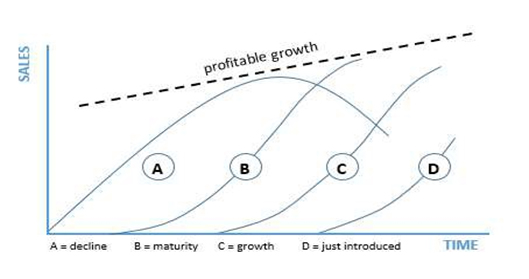
Diagram 2.2. Multiple products at different stages of the product life cycle
This diagram shows four products, here labelled A, B, C and D. Product A was produced first. While it was still in the Introduction stage, Product B was launched. While Product A was in the Growth stage and Product B was in the Introduction stage, Product C was launched. While Product A was in the Maturity stage, Product B was in the Growth stage and Product C was in the Introduction stage, Product D was launched.
What is the purpose of the regular product launches while earlier products are still in the early stages of the product life cycle? It is to maintain profitable growth (the dotted line), and keep sales growing steadily.
If Product B had been launched when Product A had already reached maturity, it's likely that sales would have declined before Product B had reached a sales level where its sales could match or replace Product A's declining sales. This would result in a dip in the sales, resulting in an M-shape: a dip before another climb. A business would rather have steady sales growth than violent swings up or down. Why? Because this means that the business is stable, and there will be no difficulty covering the ongoing investment in the business, nor the costs of running the business.
Product life cycle is one way of thinking strategically about products and publishing lists. The Boston Consulting Group (BCG) matrix is another. A matrix is a set of assumptions arranged in a rectangle or square, treated as a single idea and manipulated to help you think through different scenarios. The BCG matrix helps you think about the life cycle of products, and how they contribute (or not) to the publishing company growing its market share in a market sector.
The BCG matrix was devised in the 1960s in the United States; it can help a company analyse its products according to market growth and market share. It helps you decide where to invest, develop, or discontinue and divest of products or services.
It could be helpful when you have to review your whole publishing list, and decide which books will have new editions, which ones you will put out of print and for which customers you will conceptualise new books.
You will need data about the market share of your book, books or list, and information on whether the market they compete in is growing, stagnating or declining. You will plot each book, or list, in one of four squares in the matrix, for discussion with senior managers.
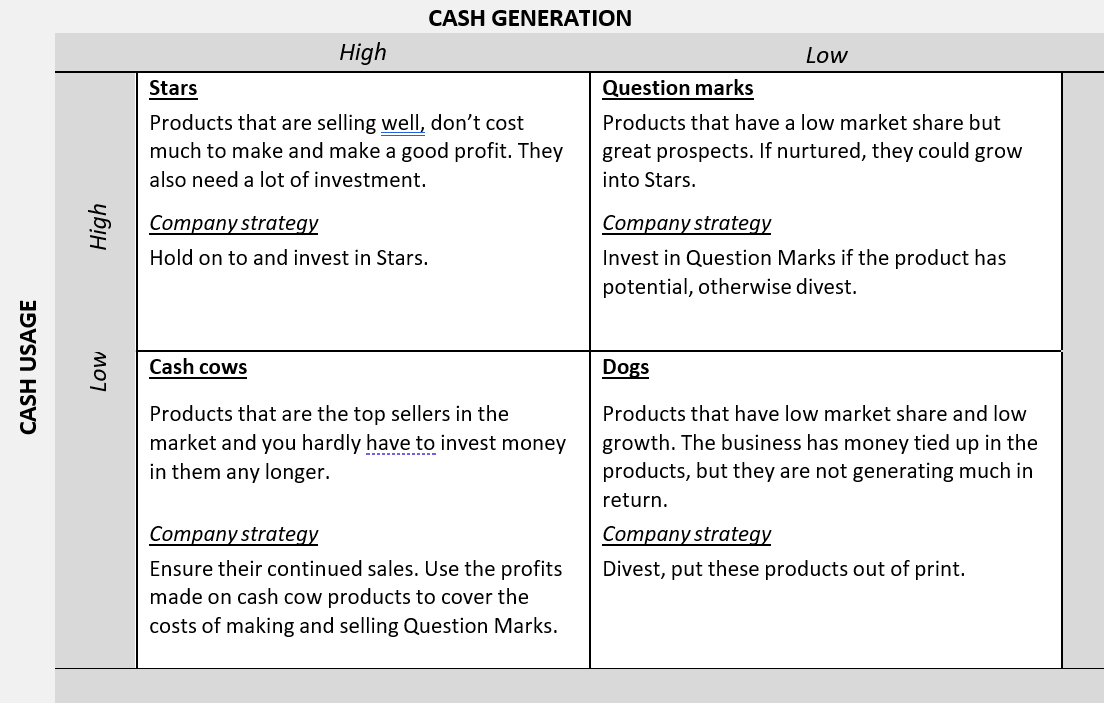
Diagram 2.3. A BCG matrix for publishing
The BCG matrix classifies products into four main types: Dogs
- Question Marks Stars and
- Cash Cows.
The classification depends on a product's market share and whether the market it's in is growing, stable, or declining.
So, for example, products that are Dogs have low market share in a market with low growth – they are poor performers. Question Marks have low market share, but are in a market with high growth – these products have potential but are not performing well currently. Stars have high market share in a market with high growth, while Cash Cows have high market share in a market with low growth – their sales are likely to decline over time.
The general aim of a business is to have as many Stars and Cash Cows as possible, and to reduce the number of Dogs. Although Question Marks will not be bringing in a large proportion of revenue, they are a necessary part of the product mix. A business would hope to grow Question Marks into Stars, and Stars into Cash Cows. Dogs are likely to be tolerated for a short while, and then probably put out of print.
The point of using these ways of thinking about product is to help you give each type of product the appropriate share of resources and attention. So, a business would be wasting resources if it spent a great deal of effort trying to turn a Dog into a Star. That effort would be more effective and likely to yield results if it was spent on a Question Mark (to increase its market share), or on a Star (to maintain its market share against fierce competitors). Equally, using many resources on Cash Cows may also not make sense, as the Cash Cow market is by definition not growing.
If you are appointed as a commissioning editor, one of the most useful things you can do is to become familiar with your publishing list's front list and back list – not only the list of titles, but also their sales performance. Knowing the sales performance of the titles you are responsible for will also be a great help to you when you are preparing a new publishing proposal, as it will help you to predict how a new product might sell.
You’ll learn more about sales data analysis, sales reports, and stock reports in Chapter 11. Two stock report templates are provided at the end of Chapter 11 – one with sample data in it, and a blank template.
Perhaps the publishing company you work for produces a stock report for each list. Perhaps there is a way to view your list's performance over time using software that you can change to suit your needs.
A stock report usually gives you information about what stock is in the warehouse and what orders must still be filled. It also typically provides information about the sales volume of titles over the last few financial years, as well as the current year. This is very helpful information when you are trying to get a sense of which of your titles are Dogs, Question Marks, Stars, or Cash Cows. It will also help you if you want to understand which of your titles are in the Introduction stage, Growth stage, Maturity stage, or Decline stage. And if you are involved in deciding which titles to reprint and how many of each, it will give you solid information on which to base your decisions.
Analysing information about the sales of a product to help you understand your list, propose new products or decide on reprints, is called sales data analysis.
Start off by looking at the stock report (complete with sample data) provided in this course. Let's look at Title E as an example: it has sales that seem to be declining over the last four years (including the current financial year). It sold about 14,000 copies three years ago, then about 12,000 copies two years ago, then about 9,000 copies a year ago, followed by the current year with about 6,000 sold so far. This title could be a former Cash Cow that is now in Decline. When you see these figures, you may wonder whether it would be worthwhile considering a new edition. You’ll want to find out what could have contributed to the decline. Was it the actions of a competitor, or changes in the external environment?
Title N is an example of a product in the Introduction stage. It was only published (2018-02-10) a year before the date of the stock report (2019-02-21). Sales have been low so far.
How you analyze the information on your list's stock report, or in the software you have available, will depend on the sector you are in. If you publish educational textbooks for school, you may want to look at all the titles for a particular grade or group of grades together. This could show you which year a curriculum was implemented by the Department of Basic Education. It may help you to estimate when you will need to revise these books.
If you work in the trade sector and publish novels for adults, you may want to look at sales by month, rather than only by year, in case there are seasonal trends that show you when it is best to publish a new product, e.g. before Christmas.
Knowing the performance of your list will give you insight into what is likely to do well in the future. It will help you identify which titles are your Cash Cows, Stars, Question Marks, and Dogs, so you can take appropriate action for each one.
There is another kind of sales data analysis you can do, if you can access the information. This is analysing your competitor's sales. Some publishing sectors have companies that gather and sell access to sales data, e.g. from a list of online or brick-and-mortar bookshops. If the company you work for has access to this kind of sales data, it can be extremely interesting and informative to see your products' sales in the context of competitors' sales.
Sometimes an industry body such as PASA, or an academic institution, such as the University of Pretoria, gathers sales information from publishers and other industry stakeholders. The information is then made available to members (in the case of PASA) or to the general public (in the case of the University of Pretoria).
Neither of these types of information (competitor sales or industry sales) may be complete or 100% accurate, but they offer a perspective that is otherwise very hard to get, as publishing companies usually regard their sales data as confidential and business-sensitive.
A market is a group of customers (organisations, or individuals) for a particular product or service. They share a common problem and are looking for solutions to it. For example, the market may be general readers in South Africa who want books to read for entertainment. In Chapters 4, 5, and 11, we look further at market segmentation, target markets and ways of reaching them.
When you are analysing “the market” for a potential product or an existing product, one of the key figures to calculate as soon as possible is the size of the market. Sometimes this is relatively easy to work out. For example, the market size for a textbook for Grade 4 children studying isiNdebele as a Home Language must start with national enrolment information.
But sometimes the size of the market can be very hard to calculate. For example, what is the market for a youth novel? This is a book that is bought and read for entertainment, not for study. Enrolment figures may give you an idea of how many children of 14- to 16-year-olds there are, but won't tell you whether they'll be interested in this particular book, like reading, live near a bookstore, have money to spend on books, or look out for new books. In cases like these, past sales information may be the best guide, along with industry data about how many different novels were bought in the last few years, and the average number of copies bought of each one.
Market size can be measured in terms of readers or users of your product, the amount of money spent on this kind of product, or how often buyers buy this product. For example, people buy reference books much less often than they buy toothbrushes! This affects how many copies of each you could expect to sell.
Market size can also sometimes be measured by access to technology. For example, if your aim is to sell an e-book in schools, you need to understand not only how many learners will have access to the textbook but also how many devices (i.e. tablets, computers) are available per learner.
Once you have worked out the current size of the market, you may want to spend some time working out the past size of the market. This will help you see whether this market is growing or declining over time. Then you can start to form an idea about what the market is likely to do in the future. This is called a trend.
The size of the market is important because all of your later calculations will use this figure as their basis.
It is also very important to know what the market trend is. If you have 50% market share of a market of 1 million readers this year, but the trend is for the market to shrink each year, your market share will be worth less each year, even if the share percentage stays the same.
So:
2019: 50% market share of 1 million readers for a product that will yield sales revenue of R10 can be worked out like this: 1 million x R10 x 50% = R5 million
But if the market declines by 20%:
2020: 50% market share of 0.8 million readers for a product that will yield revenue of R10 can be worked out like this: 800 000 x R10 x 50% = R4 million
R4 million may still seem like a large amount of money, but the difference between the sales revenue of the two years is 20%. If you had a growing market, instead of a declining market, your calculations would look quite different!
So:
2019: 50% market share of 1 million readers for a product that will yield sales revenue of R10: 1 million x R10 x 50% = R5 million
But if the market grows by 20%:
2020: 50% market share of 1.2 million readers for a product that will yield revenue of R10: 1,200,000 x R10 x 50% = R6 million
In this example, the difference between the sales revenue from a declining market and the sales revenue from a growing market is the difference between R4 million and R6 million, even though the market share in each case stays the same (at 50%).
The trend in market size is just one of the factors you may need to consider as you develop ideas about how to build your list most effectively. Other trends that could be relevant include:
- the number of people using smartphones compared to feature phones, the number of people who are unemployed,
- the number of people who shop online,
- the number of students studying a particular subject, e.g. Engineering
- the number of people using a particular language as a home language, and so on.
You will hear the term “discount” used in publishing. While discounts are sometimes offered to end- users who buy directly from publishing companies, generally, when the word is used in publishing,
this is not the same “discount” concept as when you ask a retailer for discount because you are paying cash, or receive a discount at a retailer when you use a loyalty card. You can read more about market discount structures and how to work out an average discount, in Chapter 5, especially 5.2.4.
In publishing, discount means the distribution fee that publishers build in to the price of a book – what it will cost to distribute a print book via a bookshop or other channel, or an e-book via an electronic bookseller.
If you see a book or product for sale online or in a physical bookstore with a price of R230, you may think that this is the price the publishing company will receive for it. You'd be wrong. The retail price you see in a shop is made up of various components. For example:
- R230 is the VAT inclusive price. This means that the South African Revenue Service (SARS) charges VAT of 15% on this item. In order to work out the VAT exclusive price, use this calculation: (VAT inclusive price divided by 115) multiplied by 100 = VAT exclusive price. In this example, the VAT exclusive price is [(R230 / 115) x 100] = R200. SARS therefore earns VAT of R30 on this price.
- R200 is the VAT exclusive price. But the bookseller does not pay R200 to the publishing company for the product. This is because the publishing company gives the bookseller a discount or distribution fee. In this example, the bookseller gets a discount of 30%. To work out how much the bookseller pays the publisher, use this calculation: (VAT exclusive price less (VAT exclusive price multiplied by discount %) = net price. In this example, the net price is [R200 – (R200 x 30%)]= R140.
The net price is what the bookseller will pay to the publishing company for the product, unless the bookseller pays the publishing company early (in which case they may get a further early settlement discount). The publishing company may offer the bookseller an early settlement discount to encourage the bookseller to pay early, because this will improve the publisher's cash flow.
The example given above is for a brick-and-mortar bookseller, but the discount given to an e-book distributor would have a similar structure. In fact, any distributor, for example a provincial education department which distributes school textbooks, may negotiate with a publishing company for a discount. Read more about the range of discounts in Chapter 5.2.4.
We will talk more about sales projections in Chapter 5.2 and again in Chapter 11.5. For now, you should start thinking about sales projections in the context of your responsibility to build a publishing list.
What is a sales projection? It is a prediction of the number of products or services that will sell in a defined period, and the revenue that will be generated from these. The sales projection is made based on three factors:
- past observations e.g. past sales trends, or
- undertakings given e.g. in budgets, or
- an understanding of market dynamics.
What do we mean by short-term and long-term sales projections? “Term” means a period of time. Short-term means occurring over a short period of time. In the financial world, short-term can mean a period of a few months or up to 12 months. Medium-term means intermediate in nature or lasting a few months or years beyond the present. Medium-term usually means one to three years. There is no fixed definition of how long long-term is. It can be anything above three years. In your company it might mean five to 10 years.
When developing your publishing list, you may need to estimate
the future sales of existing
products, and
possible future products,
as depicted in Table
2.3:
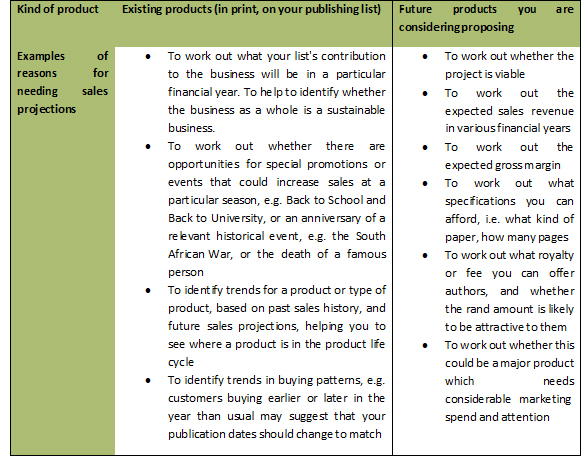
Table 2.3. How a commissioning editor can use sales projections
It's likely that you will work closely with a sales colleague to work out sales projections, as sales people interact with customers such as booksellers, provincial education departments or non-profit organisations frequently. You may also do research to find out more, e.g. conducting a phone survey.
For short-term sales projections for an existing product, you could look at how many copies or downloads (of a digital product) you might get between now and the end of the financial year, or the end of the selling season.
For long-term sales projections for existing product, you may want to calculate projections depending on how long your products usually stay in print.
To come up with sales projections (whether short- or long-term) for an important title, you and a sales manager might work through all the major channels to market (such as bookstores or retailers) and, for each one, look at:
- How many of this product this customer bought last year and the past few years, and what the buying trend is,
- How their business is doing, both internally (e.g. have they had major staff changes that could disrupt buying?) and externally (e.g. do they have a major new competitor?),
- What is likely to impact on their customers, e.g. an increase in VAT, a downturn in the national economy,
- Whether their main market is growing, stable or declining,
- Other specific factors that are relevant to this particular product.
Publishing companies are often careful about who they share sales projections with. They know that sales projections can never be 100% accurate – no one knows exactly what will happen in the future, after all! They may not want to share full sales projections with authors or prospective authors. If you tell an author that you think her book will sell 50,000 copies, she will definitely be disappointed if the book only sells 10,000 copies. And if you tell an author that you expect to sell 500 copies of his book, he may wonder why he put all that effort into writing it, or, if he has not yet written it, may decide not to! The publishing company may also want to prevent a competitor getting hold of their sales projections as it could give the competitor insight into their sales and marketing strategy or overall business strategy.
But there can be times where you want to share some sales projections. If you are trying to get a good author to work on a new project and you think the product will sell a large number of copies, you may decide to share this with the author, to increase the chance that she will agree to take part. In this situation, it could be a good idea to:
- Share with the author how you worked out the sales projections so she can see why you came to that figure (in broad terms),
- Remind the author that sales are never guaranteed and projections are only projections.
A stakeholder is someone who has an interest in or who is invested in something, like a business. A stakeholder can mean the people who actually own a business, or it could be the people who have an interest in its success. This is a much wider group that would include, for example, the staff, customers of the business, suppliers to the business, as well as the café nearby that sells food and drinks to many of the staff on a daily basis.
The main idea with stakeholder analysis is to understand and respond to the needs of those who have an interest in your product and can influence it.
There are many situations in which stakeholder analysis might be helpful, for example:
- When you are preparing a proposal for a new project and want to ensure you shape the project appropriately,
- When you are preparing to present your proposal for a new project and you want the best chance of getting it approved,
- When you are presenting your new project to prospective authors, sales people, or possible customers, and want to ensure that you focus on the aspects most important to them.
When you are preparing a proposal for a new project, you will need to get input from stakeholders on the concept of the project. Some stakeholders will be within your organisation: sales colleagues,
marketing colleagues, your manager, the finance manager, the warehouse manager, and your own team.
Outside of your organization, you may need the input of a key lecturer and prospective author (for university textbooks), an examiner, a range of teachers, and a curriculum manager (for school textbooks), or a well-regarded book reviewer, bookseller, or blogger (for a new novel).
When you are preparing to present your proposal for a new project to senior managers, you need to have done your best to think about the stakeholders that will be at the meeting, and what their areas of concern are likely to be. If you know that a finance manager attending the meeting is determined to ensure that each new project reaches gross margin targets, it is silly to hope that she will ignore the costings document that shows your project doesn't meet them. Include a comment in your proposal that motivates why the project should be done despite not meeting gross margin targets. For example, you could mention that an influential customer has committed to ordering a large number of copies, or you might include an extract from a review by an influential person saying how innovative the project is and how few competitors it has. Even better, you could show how the project is able to meet gross margin targets after 18 months of projected sales.
When you are presenting your new project to prospective authors, sales people, and possible customers, you also want to ensure that you understand their concerns and what they care about.
Is the curriculum manager at a provincial department of education motivated by the desire to improve learners' results at Grade 12, or is he motivated by looking good in front of his boss? Is the key lecturer and prospective author motivated by the idea of earning royalties, or by the idea of having her name on a book (and a book on her CV)?
You can see that it would be useless to say the same things to a stakeholder who is motivated by money, and a stakeholder who wants to improve learners' results. This doesn't mean you lie! It means that you choose what to emphasize when you talk to stakeholders, so that you align what you say with what motivates them.
Sometimes, after you have analyzed your stakeholders and their needs, you may decide not to approach a particular person because you cannot offer enough of what they care about, or you may decide to change your offering to him or her.
Think about this scenario as an example: an author is motivated by money. The book that you want to propose may not sell many copies, so the royalties are likely to be low. You may decide not to approach this author, or you may decide to try something different, such as:
 Offer her a fee per page for writing
rather than a royalty (see Chapter 6) – this way the author
knows exactly how much she
will earn, instead of the uncertainty
of royalties,
Offer her a fee per page for writing
rather than a royalty (see Chapter 6) – this way the author
knows exactly how much she
will earn, instead of the uncertainty
of royalties,
Ask her to act as a reviewer for a fee, rather than write large parts of the book – this will take less of the author's time,
Offer her a lower royalty on the first certain number of copies sold, with a higher royalty if the book sells more than the initial number,
Search for a different author, e.g. someone motivated by having a book on his CV, and ask him to write as a team with the first author.
Understanding your stakeholders wherever you encounter them will enable you to be more effective
You can use Diagram 2.4 to plot the relative importance and interest level of your stakeholders:
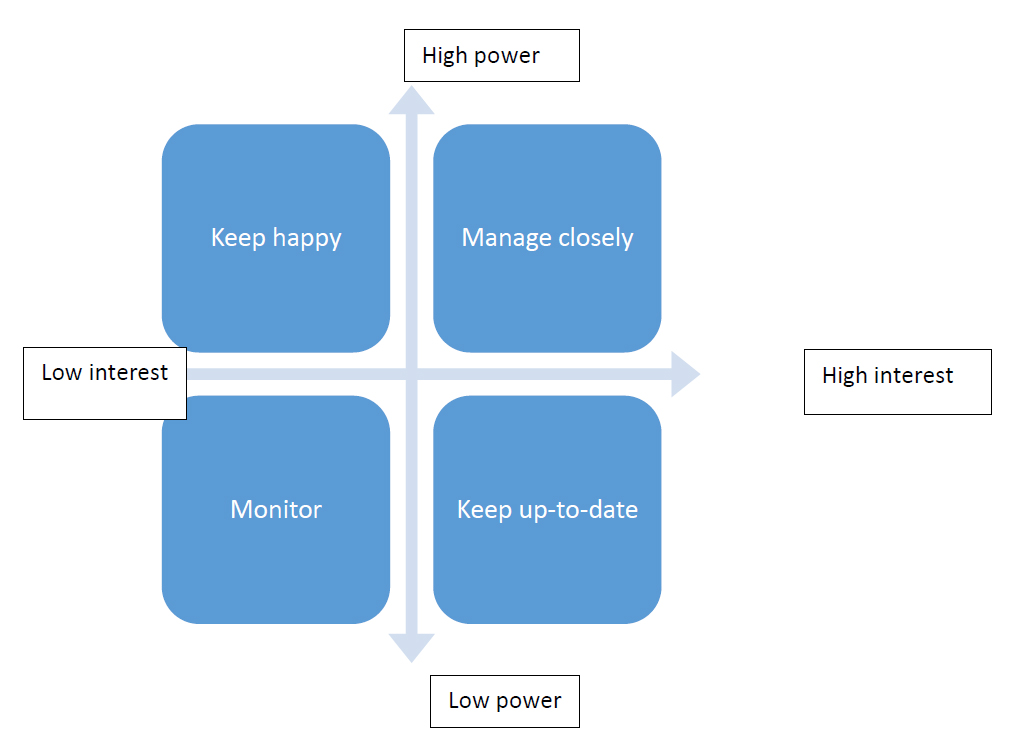
Diagram 2.4. Managing stakeholders
Broadly, there are two kinds of products in publishing:
Products that the commissioning editor conceptualizes and commissions – examples include textbooks, reference works, some biographies and guidebooks,
Products that an author has conceptualized and written (at least some of) and which he has offered to a publishing company – examples include novels, picture books for children, some autobiographies and some biographies.
The important difference here is who is doing the conceptualisation – is it the commissioning editor, or is it the author? If it is the commissioning editor, then it is very likely that the commissioning editor will have to find authors for the project.
You may need to include details of suitable authors in your publishing proposal if the authors are crucial to the project's sales success, or you may only need to identify them later, after a project has been approved by senior managers.
Finding suitable authors is often a process of balancing practical considerations with more strategic considerations. For example, it may be essential that your authors use email and can prepare their content on a computer. Or it may be essential that your authors live in a particular part of the country, or work at a particular university. These are practical considerations. More strategic considerations may be that they have an approach that aligns with the educational curriculum that you are making a product for, or that they are very well-known to potential customers.
If you are working with a team of authors, rather than just one, you can think of the team members as having different but complementary roles. For example, you might want Author A to be a full-time writer and do most of the writing, while Author B, who is a current teacher, contributes activities and reviews the first author's work. Author B brings a practical knowledge of the classroom but may not have much time to write (except in school holidays); she may not even be a very good writer. Author A, on the other hand, may understand the curriculum and have taught in schools (if this is your market) twenty years ago, but be a little out of touch now. He may have plenty of time to write and be very experienced in writing textbooks. You may then want to bring in Author C who is an examiner; she will know what parts of the curriculum learners struggle with in exams. Author D may be a teacher in a rural school, with very few resources, unlike the other teacher, Author B, who works in an urban school. Author D will understand the particular issues and experiences that rural learners will bring to the classroom and will try to ensure that these learners' needs are not forgotten in the development process.
When you are new to commissioning, you may find it hard to know where to find suitable authors. Don't forget that you will be taking over a list with a front list and a back list. Authors on your own back list may be a good place to start. Perhaps they are suitable to write again. Perhaps there is a contractual obligation to include them (e.g. on a new edition), or perhaps they can suggest others who are interested, or may meet some of your criteria.
These are some of the other places and ways that you can find suitable authors: Conferences on a relevant topic,
- Authors of academic papers on relevant topics,
- Award-winning teachers or teachers at award-winning schools, University or college lecturers that are well-regarded by their peers,
- Organizations related to your topic, e.g. members of a South African Historical Society if your new project is on an aspect of local history,
- People who blog in an informed way about an issue and have a large number of followers – the same goes for those who are active on other types of social media, e.g. Facebook and Twitter,
- People who are recommended to you by people who are knowledgeable about the topic, e.g. curriculum advisor in a provincial education department may recommend a school or teacher as possible authors or a source of authors in their province.
Once you have identified a number of possible authors, start contacting them. Talk about your idea in general without promising they will definitely be invited to join the author team. Find out what you can about what motivates them, so that you can emphasise the things that may appeal to them.
If someone turns you down outright, don't be afraid to ask if she can recommend someone else. Once you have spoken to four or five people, you will feel more confident about making a choice. You will be able to narrow down your list of possible authors to those who you really would like to work with, and that are likely to complement one another in a team.
Some people may be immediately enthusiastic about the idea, but others may take quite some time to be convinced. In your efforts to bring on board the people you have chosen, don't forget to do some practical vetting before you actually commission and contract them. Getting prospective authors to write a sample section of content will give you a much better idea of what they are capable of than a CV. Watch out for people who are difficult in the early stages – they may continue to be difficult throughout the project.
After studying this chapter, you must be able to:
- analyze the concept and principles of front list management and the important mechanisms to ensure viability.
Sometimes it is very easy to identify a market opportunity. For example, if a new school curriculum is introduced, it's almost certain that most textbooks that children currently use will need to be replaced with new ones in the next few years. This presents a clear market opportunity. The difficulty in this scenario is not to identify the opportunity, but to get enough information about the new curriculum and the timeline for its implementation so you can start developing product in an appropriate way.
Another example would be when a new driving test is introduced. The old learning materials would become useless and people would need to buy new books.
Most market opportunities are not as easy to identify as these. Rather, they require effort on the part of the commissioning editor and her colleagues. Diagram 2.5. shows six examples of how you can identify market opportunities. Most of these involve research. Chapter 3 will give you more information on conducting research in an effective way.
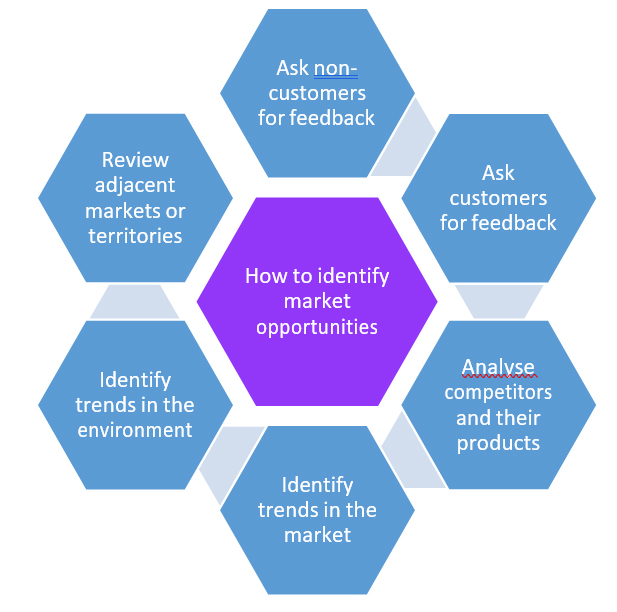
Diagram 2.5. Examples of how to identify market opportunities
Asking customers for feedback is a good starting point for your research. You may be able to use a free online survey tool, such as Survey Monkey, Google Forms, Type form, Zoho Survey, or Responster, to ask your customers specific questions. Direct conversations can also be effective, especially if you can meet in person and build a relationship. You are hoping that your customers may say things like, "I love this product, but it would work even better for me, if it did X" or "if it had Y". X and Y could be ideas for new products that sit alongside your existing products.Analyzing the strengths and weaknesses of competitor products (and of the competitor business as a whole) is always useful. But you need to be careful that you include the point of view of people who use the product, not just your own. It can be very easy to see the faults of a competitor, but sometimes users don't care about these "faults" because the competitor product has features that they really appreciate. Try to find out about these features, and don't make this an exercise in proving that your product is better.
It's vital to stay up-to-date with trends in the market. For example, if customers are moving online and are starting to use apps instead of print or web-based products in your subject area, you will need to understand why customers are behaving that way, and how you can respond to it competitively. You also need to stay up-to-date with experiences that your customers might be having. If your customers are shopping online, you need to ensure you experience that too, so you know what a good (and a bad) online experience feels like.
Knowing what's happening in the broader environment is also important. For example, a sudden reduction in the cost of data for cellphones could impact on your business, especially if the company you work for makes digital product. Or if all public schools in South Africa stopped charging parents school fees, would this present a market opportunity? These parents may suddenly have more money to spend.
Sometimes it's also worthwhile reviewing adjacent or similar markets, or even territories. Let's take adjacent territories first. If you have been successful in providing atlases to school children in South Africa, perhaps the curricula of neighbouring countries such as Namibia, Angola, Mozambique, Botswana, and Zimbabwe also require learners to have atlases? If other publishing companies aren't already supplying atlases in these territories, or their atlases are old or uninspiring, there may be multiple market opportunities to investigate.
An adjacent market doesn't have to be physically close by. The music industry, for example, is often thought of as a parallel industry to the publishing industry because both work with copyrighted content and have been challenged by digital innovation in the last 10 to 20 years. If you read about the experiences and actions of music companies during this time, you might have some fresh thoughts about the publishing industry, what new products might be worth making, or new opportunities for existing products.
The last example of how you can identify market opportunities is, "Ask non-customers for feedback". Perhaps this seems like a strange thing to do, because these people or businesses have decided not to use your products. But if you find out why they decided to use competitor product, you might gain useful insight into how these people perceive your products and your brand, and what could make them choose yours in the future. This might give you ideas for new products, or suggest ways that the company you work for could improve or change its service or reputation.
Before you start working
on publishing proposals and full costings for new products for your front list, you may need to suggest in general terms what you want to put on your front list. This may be done in
different ways at different
publishing companies, but budget
season is one of the
times that most companies
will want to know in advance
what you would like to publish.
There is more information about budgeting in Chapter 5.3.
Each year at about the same time, most publishing companies draw up their budgets for the following year. As a commissioning editor, you may take part in this in various ways, like:
Diagram 2.6 shows what you may have to do for each financial
year.

Diagram 2.6. Budget
requirements for each financial year
There is more information about budgeting in Chapter 5.3.
Each year at about the same time, most publishing companies draw up their budgets for the following year. As a commissioning editor, you may take part in this in various ways, like:
Identifying your front list titles for
the next
financial year or years,
Working out how much you will need to spend to develop and produce those titles, along with any other work
that is currently in progress.For the financial years following Budget year 1, you will draw up a list of titles for your front list, and then discuss the list with informed colleagues in the business. You won't have proposals for these titles at this stage, but you should be able to describe the titles and why you are suggesting them. You should also listen to what your colleagues say about your ideas. If you don't address their concerns before you present your actual proposal, it's likely that they will raise the same issues in that meeting. It's not essential that you do what they say (especially if you have market research to back up your approach), but you should consider their point of view with an open mind. Be prepared to start a discussion about what would be best. After all, if these are sales or marketing staff then your product will almost certainly need their buy-in in order to be successful.
The publishing company you work for may use a spreadsheet template or special software for its budgeting process. This spreadsheet may require you to enter certain information about each proposed front list title, including for example:
- Title
- Publication date Selling price
- Type: print or digital
- For print titles: first printrun quantity, reprint quantity
- For print titles: first printrun quantity cost, reprint quantity cost For digital titles: lifetime sales quantity
- Discount
- Costs of producing the content.
Another criterion may be whether the sales from your front list as a whole add up to an appropriate amount or a target amount for your list. If you have suggested a number of minor titles, but nothing that might bring in its own significant sales, you might have to motivate why that is so.
Or perhaps you have suggested one major title and several supporting titles for it. The senior managers may consider this list to be unbalanced and too high risk. They may worry about what sales your list will bring in if that title does not work out, if an author becomes ill, or there is a dispute.
Generally, a publishing company would like to see several interesting new products that could turn into major sellers. This lowers the risk. If the author team on one of your three major titles disintegrates or fails to deliver, it's likely that the others will continue, ensuring a steady publication rate and therefore steady sales potential.
Alternatively, perhaps a colleague of yours, another commissioning editor, has a particularly large project on her suggested front list, in response to a particularly appealing market opportunity. The senior managers of the company may like the idea, and want to continue with it, but also be aware that this project will mean there is less money to spend on your projects, as her project will use a larger portion of the available money than usually expected.
They may, in this situation, ask you to postpone some of your suggested projects, or trim them down to their essentials, in order to allow your colleague to have the money she needs to develop her large project. This could be disappointing for you in the short-term, but, if your list had the big market opportunity, the same would be done for you.
At the end of this section, you must be able to:
- Analyze the concept and principles of back list management and the important mechanisms to ensure viability
Managing a back list well is a little like managing
an established garden.
If you ignore it and focus only on your front list, you will find your back-list
garden is soon overgrown, with weeds crowding out the
plants (titles) you want, and
pests destroying the fruit or the
roots (market share).
A back list does need less attention than a front list, but if you want it to perform in the best way possible, you will need to tend it regularly and give it strategic thought.
The most important way to keep your back list performing well is looking at it regularly, once a week or fortnight, or month. In the selling season and just before, you should probably set aside time every week. Out of this period, looking at it once a month may be sufficient. Your publishing company may produce a stock report that you can look at weekly or monthly, or else you may have access to software that will show you what you need (e.g. back list only, or performance against budget or last year).
In terms of performance, there are several ways of measuring your back list that can help you evaluate which products need attention. These include:
Let's take each of these
in turn.
A back list does need less attention than a front list, but if you want it to perform in the best way possible, you will need to tend it regularly and give it strategic thought.
The most important way to keep your back list performing well is looking at it regularly, once a week or fortnight, or month. In the selling season and just before, you should probably set aside time every week. Out of this period, looking at it once a month may be sufficient. Your publishing company may produce a stock report that you can look at weekly or monthly, or else you may have access to software that will show you what you need (e.g. back list only, or performance against budget or last year).
In terms of performance, there are several ways of measuring your back list that can help you evaluate which products need attention. These include:
- Sales volume (the number of copies sold in a period)
- Sales value (the amount of money generated by the number of copies sold in a period) Sales trend
- Gross margin
- And gross margin trend.
Sales volume: if
a title starts selling fewer and fewer copies,
you should consider why. Is there a new competitor? If so, buy it and compare
it to your own title, or pay an expert to do so. Perhaps the title is edging out
of maturity and into decline
(see
section 2.1.3 on the product life
cycle). What can you
do to keep it competitive? Or do you need to speed up a new title to take its place more quickly than you were
planning?
Sales value: if a title starts bringing in less and less money, but its sales volume is steady, each sale must be bringing in less. Has the company started giving a bigger
discount to an important
customer, or was there perhaps a mistake in the discount
on a large sale? Or perhaps the problem is not the discount,
but the pricing.
If you have a title that has not reprinted for some time, you may have forgotten (or decided not) to put the price up at price increase time. This can result in the price of the title starting to be out of line with other similar
titles. If so, act as soon as you can, to stop the slide in
sales value.
Sales trend: both of the above points benefit from an understanding of the trend on a title over time. If you compare the sales (volume or value) in this financial
year with what was happening on this title in the past financial year (or years),
do you see a pattern?
Do sales often dip between April and September, for example? If so, and if they have dipped this year at that time, you probably don't need to do anything. But if sales are usually
steady but this year have dipped, it's worth
investigating why. Talking to sales colleagues may be the best way of doing so, or you may want to go directly to key customers, such as
a e-book distributor or bookstore
group.
Gross margin: if
your company has gross margin targets, e.g. for lifetime sales for digital, or for reprints
on print, compare
your titles' gross margins
against these targets.
Are there any titles where the gross margins
are lower than you would expect? What is the reason for this? If sales are low, sometimes
a back list title is not reprinted
for two years and during that period print costs increase
substantially. Sometimes the company will
have decided not to increase the price on a title like this, because
the gross margins are climbing
and climbing and so there seems to be
no
reason to do so.
The combination of these two things (increased print costs, no price increase), or only one of them, can result in a product's gross margin tumbling when a reprint does take place. This is an example of what can lie behind a lower gross margin than expected.
Gross margin
trend: again, knowing what the trend is for
a title's gross margin can give you strategic
insight. Perhaps there is a competitor that has agreed to a higher discount with a distributor than your company usually does, and this has resulted in your company
also agreeing to this higher
discount. This is
very likely to impact negatively on a product's gross margin
over time.
If anything seems to be going seriously wrong in any of these areas, you may need to act. Examples of what you might do include:
Finally, don't forget to take a look at the actual
titles on your back list, especially (but not only) those in print. How do they compare to the other books on the shelf at a bookshop? Do they look tired, old, or out-of-date for some reason? Is there anything
that seems wrong or inappropriate in the blurb or on the cover that might be putting off potential
customers? You can usually
make small changes to a book and reprint it without
changing the ISBN (if that is a benefit to you or your customers). Don't be
afraid to spend a little time
and
money improving a back list title
if the sales data suggest
it would be worthwhile.
2.3.2. The
purpose of feedback about
published titlesThe combination of these two things (increased print costs, no price increase), or only one of them, can result in a product's gross margin tumbling when a reprint does take place. This is an example of what can lie behind a lower gross margin than expected.
If anything seems to be going seriously wrong in any of these areas, you may need to act. Examples of what you might do include:
- Investigating the situation with input from colleagues who can give a different perspective
- Renegotiating the price or discount of a product through a particular channel
- Evaluating a competitor product
- Proposing a price promotion with extra marketing support
- Speeding up a front list title that is planned to replace a back list title in trouble
- Preparing sample material for a front list title that is planned to replace a back list title in trouble
- Closer monitoring.
Fixing a problem on the back list can cost much less, in money and effort, than producing a completely new front list title, so protect and nurture your back list and you will probably be handsomely repaid for your time.
It may be a surprise to realize that research in publishing is not limited to research into the market or research into competitors that could help you conceptualize a front list title. You could commission or conduct research into a back list title.
Situations in which you might want to conduct research into a back list title include:
You need more information, or a different type of information, than sales figures can give you, even though you have analysed sales figures well, from a variety of perspectives.
Feedback on a back list title could help you make small changes (in the content or the marketing) that could help it perform even better, or help it perform as anticipated.
You want to understand what you did right with a product, rather than what you did wrong or what you could improve, so you can use this information to try to repeat your success in another product, or extend the Start or Cash Cow part of a product's life cycle.
Not many publishing companies or commissioning editors conduct research into their back list titles. Doing so can have enormous benefits. For example, if you have developed a reading scheme for school children that has done very well in one province, but has not done well in other provinces, research could give you facts about the impact of the reading scheme in the one province, which you can use to persuade other provinces to allow a trial, or even to purchase the reading scheme in bulk.
Research on a back list title is probably of less value for products such as novels for adults, or picture books for children. This is because each product has fairly low investment in development and production, and stands alone. In other words, the product succeeds or fails on its own, rather than as a series of products that have to succeed or fail together. A reading scheme, on the other hand, is a high-investment product because there are many components and it may take years to develop the scheme in full. It is not a stand-alone product. It only succeeds as a scheme, not as individual books. It is also a high-risk product for a school to buy, because a school may only change its reading scheme every 10 years. If the scheme doesn't work, the school may have to struggle on with it for a long time before being able to change to something else.
From this, one can deduce criteria for back list research. These are shown in Table 2.4:
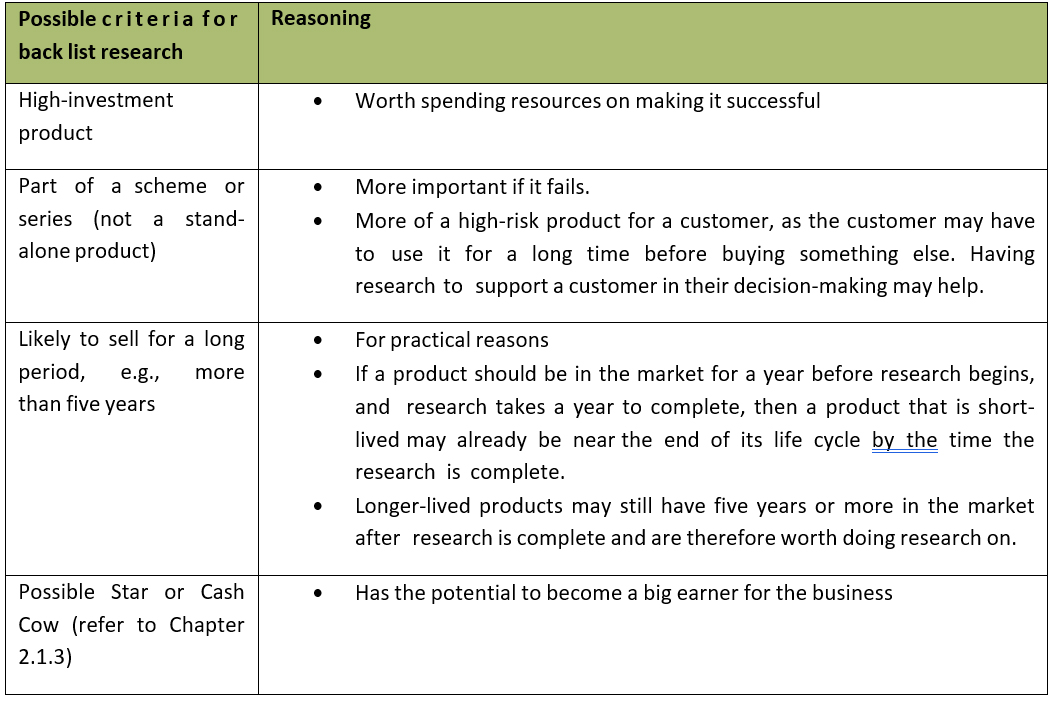
Table 2.4. Examples
of criteria for back list research
You will need to decide when to put titles on your back list out of print. This can be a difficult decision, especially if you commissioned the title yourself and worked very hard with the author to develop
it. Adding to this,
you may have a sense that the title could get better sales in the future. For example, for literature used at schools,
it's possible for a title that has sold less than 200 copies for five years or more to suddenly
receive a large order of more than 30,000 copies. This kind of experience
can make a commissioning editor
reluctant to put any title out of print.
However, other types of products, e.g. a travel guidebook or a business book detailing how to navigate a legal environment, are extremely unlikely to receive substantial orders after their sales have been failing for several years. They have probably become dated.
Putting titles out of print is a necessary activity. If a title isn't going to sell in sufficient quantities, any print copies should be removed from the warehouse, the website, and the catalogue, to give more space to titles that will sell. Refer to Chapter 11 in which stock management is discussed. It takes resources (time, and money) to keep titles in the warehouse, in catalogues or on the company’s website.
There are also implications for the authors of putting a book out of print. The rights usually revert to the author, depending on the contract governing the title. Refer to Chapter 6 for more information on contracts and rights.
The reversion of rights can be important. For a novel that is no longer selling sufficient copies in print, the author may get the rights back, make a version of the book herself (in print or digital) and sell it through physical or digital distribution channels. If the author is well-known, or is good at self- marketing through social media, publicity, or a blog, she could earn a worthwhile income from doing so.
For other titles, like school textbooks aligned to an outdated curriculum or legal textbooks where the legal framework has changed, there may be little value in the reversion of rights to authors.
Before you put a title out of print, you may want to consider the following back list tactics for improving or maintaining sales:
Most of these options
require effort, whether by the publishing, marketing or sales teams, or,
most likely, a combination of all
three.
However, other types of products, e.g. a travel guidebook or a business book detailing how to navigate a legal environment, are extremely unlikely to receive substantial orders after their sales have been failing for several years. They have probably become dated.
Putting titles out of print is a necessary activity. If a title isn't going to sell in sufficient quantities, any print copies should be removed from the warehouse, the website, and the catalogue, to give more space to titles that will sell. Refer to Chapter 11 in which stock management is discussed. It takes resources (time, and money) to keep titles in the warehouse, in catalogues or on the company’s website.
There are also implications for the authors of putting a book out of print. The rights usually revert to the author, depending on the contract governing the title. Refer to Chapter 6 for more information on contracts and rights.
The reversion of rights can be important. For a novel that is no longer selling sufficient copies in print, the author may get the rights back, make a version of the book herself (in print or digital) and sell it through physical or digital distribution channels. If the author is well-known, or is good at self- marketing through social media, publicity, or a blog, she could earn a worthwhile income from doing so.
For other titles, like school textbooks aligned to an outdated curriculum or legal textbooks where the legal framework has changed, there may be little value in the reversion of rights to authors.
Before you put a title out of print, you may want to consider the following back list tactics for improving or maintaining sales:
- Update or change the cover (and blurb) to include information about prizes it has won, or quotations from favourable reviews received after publication.
- Bundle backlist titles together at a discounted price, e.g. two novels by the same author, or two "holiday-reads" together at the start of the holiday season.
- Add a small amount of new content. Add an interview with the author, a reflection on the book done as a celebrity foreword, or a chapter from an author's earlier book to a later book.
- Insert a chapter from an author's new book into the back of one of the author's old books.
- Try to sell translation or other subsidiary rights to local or foreign publishing companies, either through an agent or through direct approach yourself. See more about selling rights in Chapter 6.
- Offer special deals, especially on price.
- Ask the author to support a title or series of titles by participating in marketing activities, like doing a reading, podcast, writing a blog post, or writing an opinion piece for a newspaper, magazine, or website. All kinds of new content can make the title more discoverable, and start people talking about it again.
- Use current events to position an author or book in a different or fresh way.
Any attempt to increase the sales of a back list has to be appropriate. The commissioning editor, together with senior managers, must weigh up the potential benefit to the business of lifting the back list compared with the potential benefit of supporting the front list. Not every book on the back list
can get the kind of attention
suggested here, but some titles are worth the effort. Make sure you understand which of your titles are Stars, Cash Cows, Dogs, or Question
Marks before you get started
on a significant back list
campaign.
Last modified: Thursday, 18 May 2023, 1:43 AM